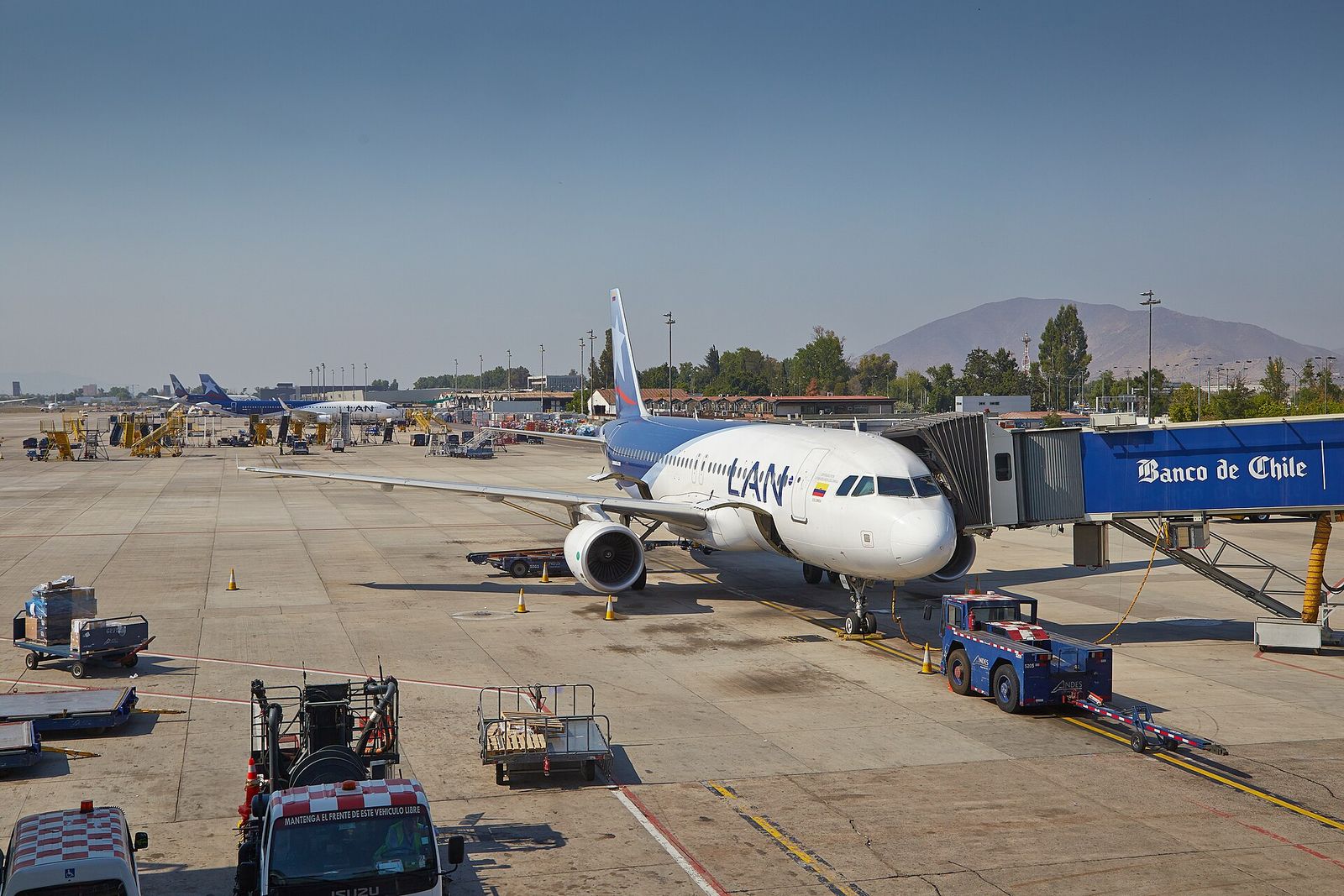
The cheapest way from Santiago airport to city center is the Centropuerto bus: CLP 2,400 one way, every 15 minutes, to Metro República, Terminal Sur or Pajaritos on Line 1, then a short Metro ride (checked 1 October 2026). An official taxi bought at the counters after customs costs roughly CLP 25,000-35,000 and takes 30 to 60 minutes.
Which one you should take depends on the time of day, how much luggage you have, how many of you there are, and exactly where in the center you’re going. This guide walks through the arrival from the plane to the transport counters, each option step by step, which bus stop and Metro line suit each part of the center, and how to handle late-night arrivals. For everything else about Arturo Merino Benítez airport, from terminals to SIM cards, see our Santiago airport guide.
The quick answer: which way into the center?
| Option | Cost | Time to the center | Best for | Where to buy |
|---|---|---|---|---|
| Centropuerto bus + Metro | CLP 2,400 bus + CLP 735-895 Metro | About 45-75 minutes | Solo travelers, daytime, light bags | Bus counters or on board |
| Official taxi | Roughly CLP 25,000-35,000 per car | 30-60 minutes | Late arrivals, heavy bags, no phone data | Official counters after customs |
| Ride-hail app | Roughly CLP 18,000-28,000 per car | 30-60 minutes, plus the wait | Most travelers with a working phone | In the app |
| Shared transfer van | Roughly CLP 8,000-12,000 per person | 45-80 minutes with stops | Solo travelers who want door-to-door | Official counters after customs |
| Private transfer | From roughly CLP 30,000 per vehicle | 30-60 minutes | Families, red-eye arrivals, business | Book before you fly, or at the counters |
Centropuerto fares from the operator’s site and Metro fares from Metro de Santiago, both checked September-October 2026; taxi, ride-hail and transfer ranges are the fares our airport guide observed in September 2026. Dollar figures use about CLP 950 to the US dollar.
The short version: alone, in daylight, with a carry-on, take the bus. With a big suitcase after an overnight flight, or with two or more people, take an official taxi or a ride-hail. For two or more people, the gap per head narrows quickly, and a car to the door is worth it once you count the stairs and the walk at the far end.
Step by step: from the plane to the transport counters
The arrival process at SCL changed with the new international arrivals exit, and the most important change is where you buy your transport.
1. Immigration. Join the line for passport control. Visitors from the UK, US, EU, Australia, Canada and New Zealand can stay up to 90 days without a visa, and you’ll receive a tourist card (Tarjeta Única Migratoria); keep it, because you’ll show it when you leave and hotels may ask for it (checked September 2026). Our Santiago travel guide covers entry rules in full.
2. Baggage. Collect your bags, keeping them in sight; the UK government warns of luggage theft at the terminal and from the carousel.
3. Customs and the SAG inspection. Chile is strict about food. All food, plant and animal products must be declared on the arrival form, and bags go through an x-ray at the SAG (agricultural service) and customs inspection. Declare anything you’re unsure of; declaring an apple costs nothing, and not declaring it can cost a fine.
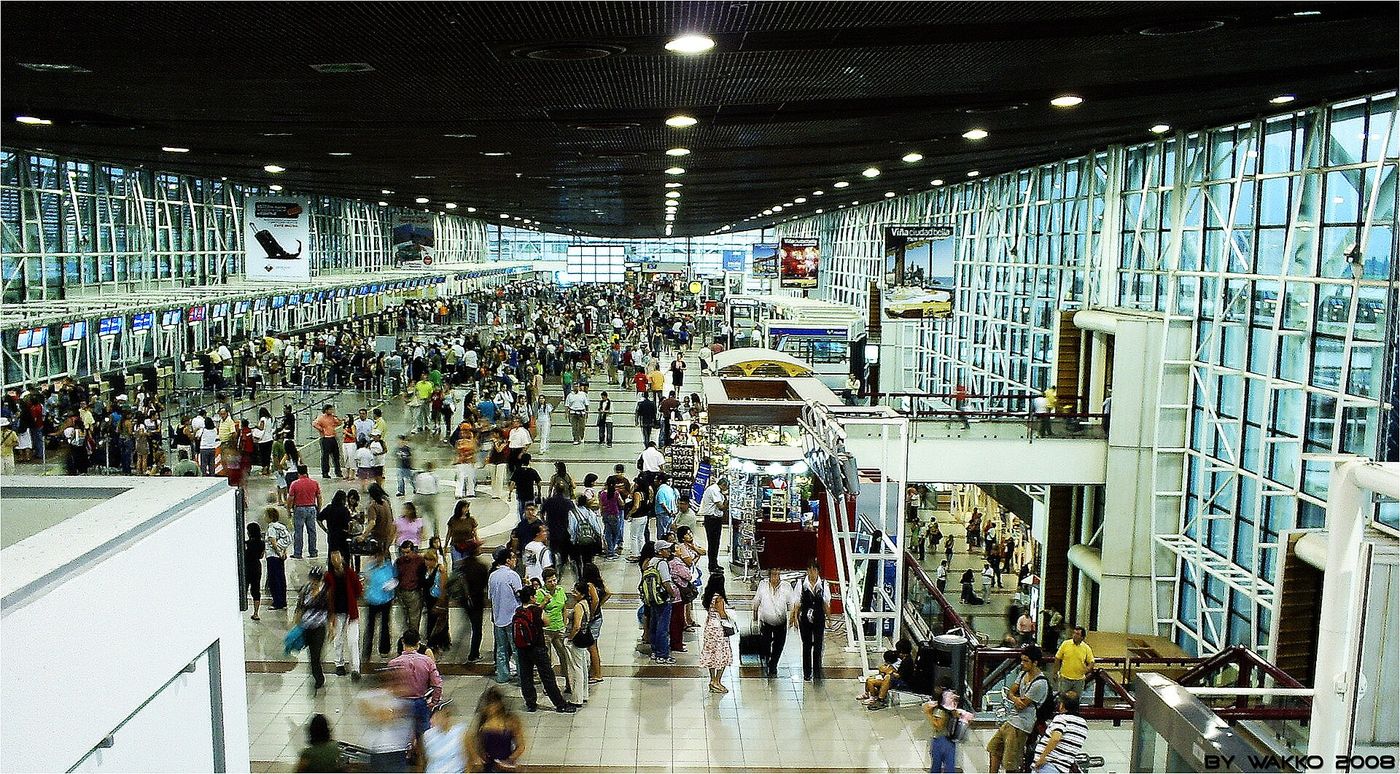
4. Follow the blue arrow. After the SAG and customs hall, the airport operator says to follow the blue arrow on the floor to the designated counters in the new transport center, a secure area separate from the public arrivals hall, where you can buy official ground transport: basic and tourism taxis, transfers or buses (checked 1 October 2026). The operator describes the center as a way to buy your transport “without the hassle of illegal drivers”. Buy here, then walk out into the public area to your vehicle or bus.
5. Ignore everyone who approaches you. Once you’re in the public hall, people will offer taxis. If you didn’t pay at an official counter, it isn’t the official service. The UK government quotes an example of an airport taxi charging CLP 5,000,000 instead of CLP 50,000, a decimal trick played on tired travelers paying by card.
That’s the whole system: everything official is bought behind the blue arrow, before you reach the public hall.
How do you get from Santiago airport to the city center by bus?
Take Centropuerto, one of the two official airport buses: CLP 2,400 one way or CLP 4,100 return, departures every 15 minutes every day, stopping at Intermodal Pajaritos, Terminal Sur and Metro República, all on Metro Line 1. Buy at the counter or on board, then ride Line 1 east to the center.
Centropuerto in detail (operator’s site, checked 1 October 2026):
| Detail | What applies |
|---|---|
| Fare | CLP 2,400 one way (about USD 2.50); CLP 4,100 return |
| Ticket | E-ticket valid 90 days from purchase; tickets also sold at counters and on the buses |
| Frequency | Every 15 minutes, every day |
| City stops | Intermodal Pajaritos, Terminal Sur, Metro República; a separate route serves Maipú |
| At the airport | Office at the airport bus terminal, opposite platform 24 |
| Contact | +56 2 2601 9883 |
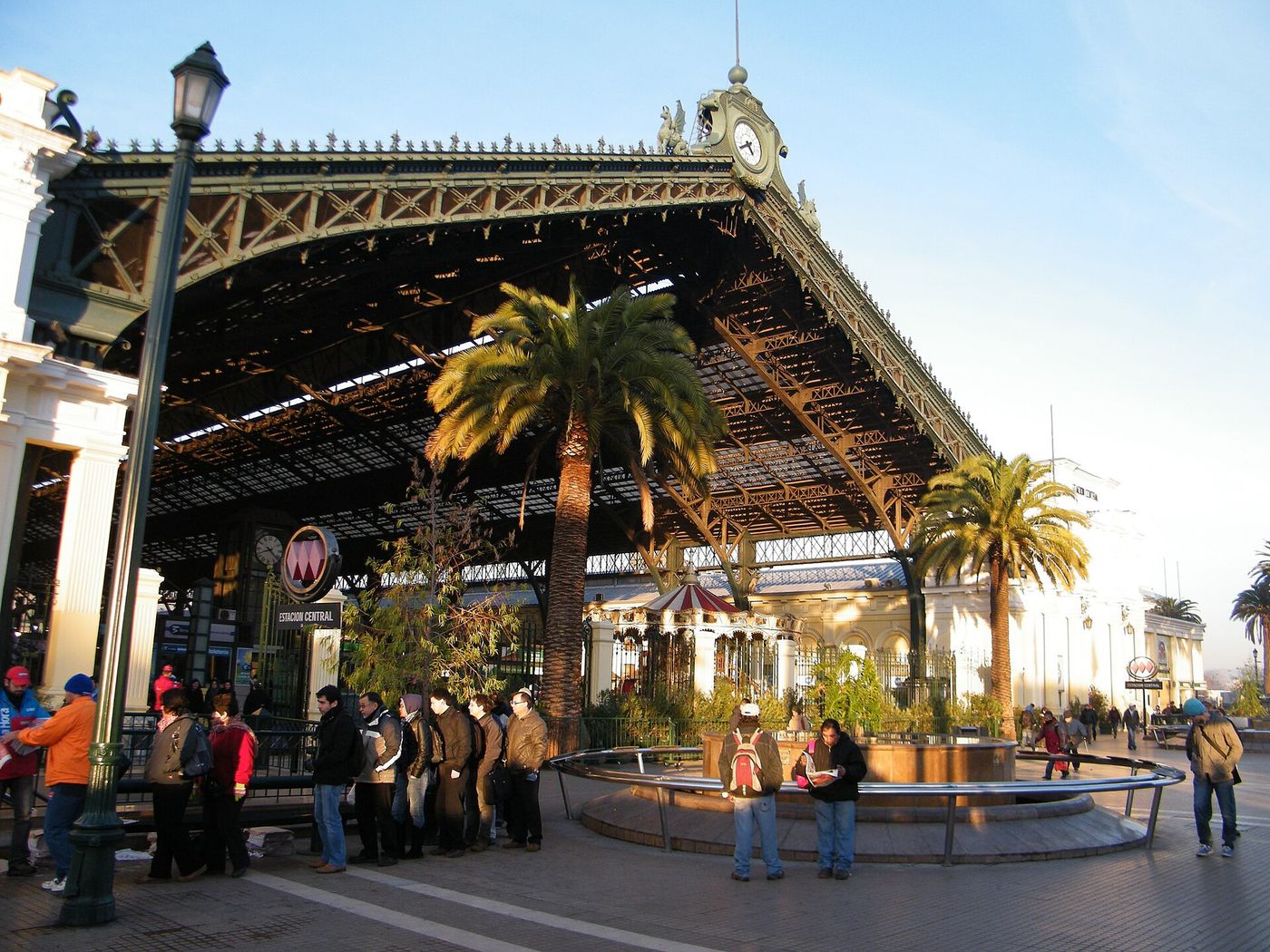
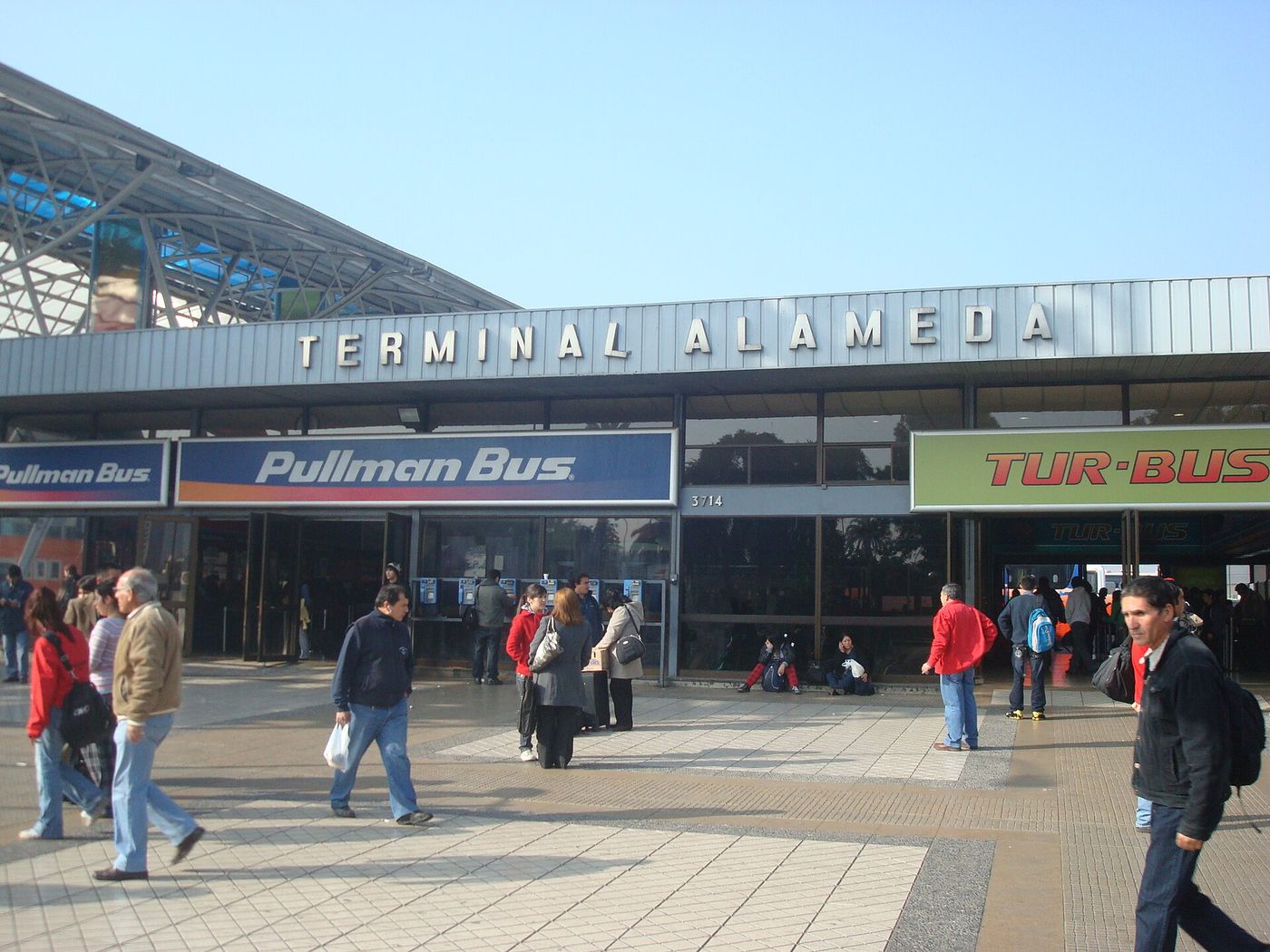
The fare applies to the whole route, and you can get off at any authorized stop. For the center, the useful stops are Metro República, the closest to the historic core, and Terminal Sur, in the cluster of bus terminals at Estación Central. Pajaritos, on the western side of the city, is the better choice if you’re heading east to Providencia or Las Condes, since you join Line 1 near its western end.
TurBus Aeropuerto is the other bus listed by the airport as official transport. Its stops and fares are sold at its own counter and buses; ask there if its route suits your hotel better.
From the bus to the Metro. All three Centropuerto city stops are on Line 1, the Metro’s east-west spine. Tap in with a contactless Visa or Mastercard, or a bip! card, and ride east. Fares run CLP 735-895 depending on the time of day, and the Metro opens at 06:00 on weekdays, 06:30 on Saturdays and 07:30 on Sundays and holidays, closing at 23:00 every day (checked September 2026). Our guide to getting around Santiago covers the fares and the bip! card in full.
What it’s like with luggage. The buses are coaches with a luggage hold, so the bus itself is easy. The Metro is where luggage becomes work: stairs at some entrances, crowded trains at rush hour and a walk at the far end. With a carry-on, it’s fine. With two large cases at 08:00 on a weekday, it’s miserable.
Which stop for which part of the center?
The center isn’t one place, and the right route depends on where your hotel is. Using Centropuerto’s Metro República stop and Line 1:
| Your destination | Best route from the airport | Metro stops from República | At the far end |
|---|---|---|---|
| Barrio Brasil and Yungay | Centropuerto to Metro República | None; walk | A short walk north into the barrio |
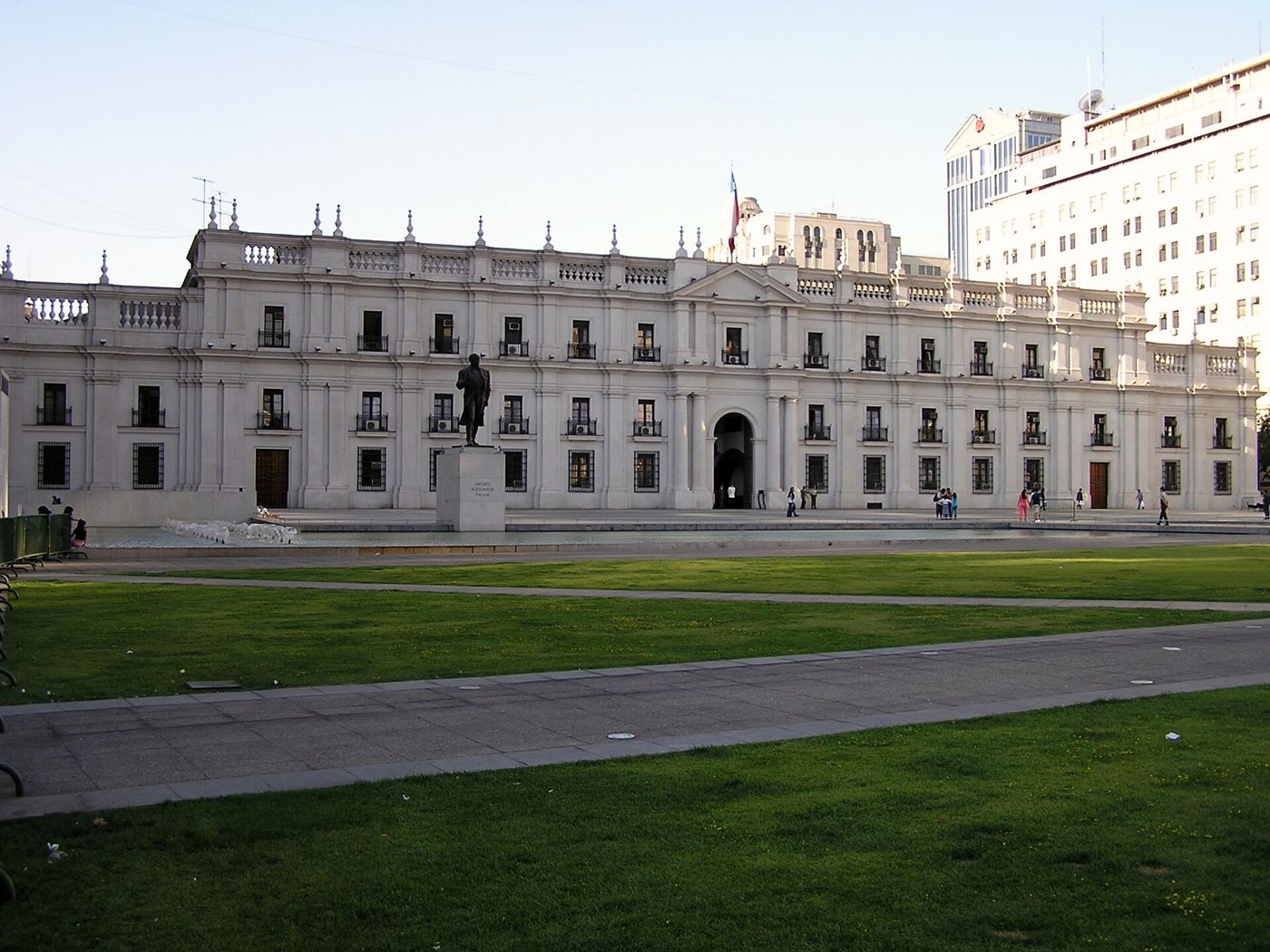
| La Moneda and the government district | Centropuerto to República, then Line 1 east | 2 (to La Moneda) | Exit onto the Alameda by the palace |
| Plaza de Armas and Paseo Ahumada | Centropuerto to República, then Line 1 east | 3 (to Universidad de Chile) | Walk a few blocks up Paseo Ahumada to the plaza |
| Cerro Santa Lucía | Centropuerto to República, then Line 1 east | 4 (to Santa Lucía) | The hill is beside the station |
| Lastarria and Bellas Artes | Centropuerto to República, then Line 1 east | 5 (to Universidad Católica) | A short walk north into Lastarria |
| Providencia | Centropuerto to Pajaritos, then Line 1 east | (Board at Pajaritos) | Salvador, Manuel Montt, Pedro de Valdivia or Los Leones |
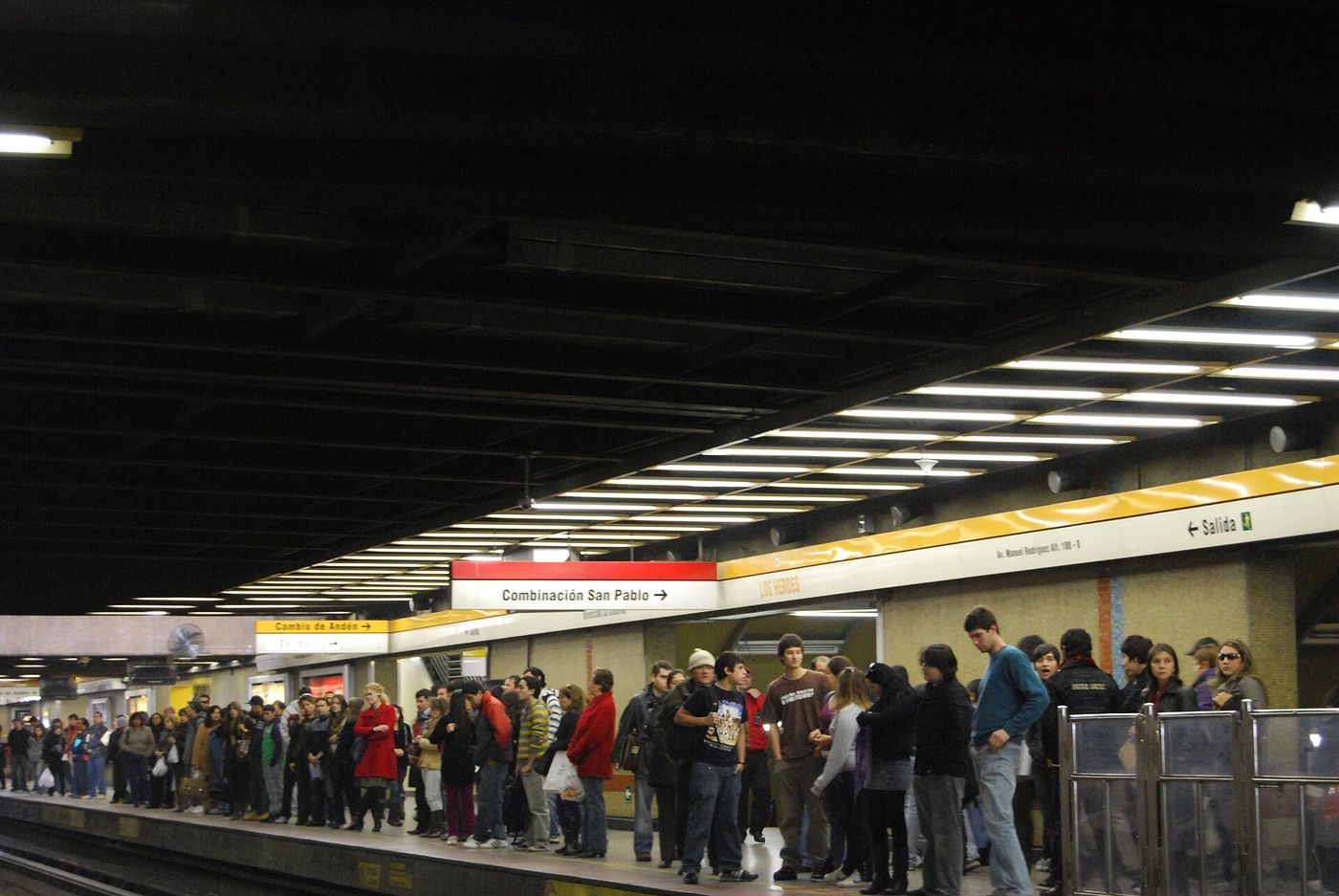
Station sequence on Line 1 east from República: Los Héroes, La Moneda, Universidad de Chile, Santa Lucía, Universidad Católica, then Baquedano and Providencia.
For Lastarria with heavy bags, a taxi or ride-hail to the door is worth it: the walk from Universidad Católica is short but crosses busy avenues, and some of the barrio’s streets are cobbled. For where to stay in the center in the first place, see our guide to the best area to stay in Santiago for a first visit.
Beyond the center: the same bus, a different Metro ride
If your hotel isn’t in the historic center, the Centropuerto bus still works, with a different Metro connection:
- Providencia: get off at Pajaritos and ride Line 1 east to Salvador, Manuel Montt, Pedro de Valdivia or Los Leones.
- Las Condes: Pajaritos, then Line 1 east to Tobalaba, El Golf or beyond.
- Bellavista: Line 1 to Baquedano, then walk north across the river.
- Barrio Italia: Line 1 to Baquedano, change to Line 5 for Santa Isabel, then walk about 10 minutes.
- Ñuñoa: Line 1 to Universidad de Chile, then Line 3 east along Avenida Irarrázaval.
- Vitacura: there’s no Metro station, so take a taxi or ride-hail from the airport, or the bus to Pajaritos and a ride-hail from there.
Our guide to getting around Santiago has the full network, and the where-to-stay guide covers how far each neighborhood is from a station.
Official taxis and transfers: what the counters sell
The airport lists two classes of official taxi, Taxi Básico Oficial and Taxi Turismo Oficial, alongside transfer vans, car rental and the buses (checked 1 October 2026). All are sold at the counters behind the blue arrow, before you enter the public hall.
How the taxi counters work, as our airport guide describes the system: you tell the counter your destination, pay a fixed fare based on the zone, and get a ticket; a dispatcher takes you to the car. There’s no meter and no haggling, and the price doesn’t change if you hit traffic. Typical fares in September 2026 ran roughly CLP 25,000-35,000 (about USD 26-37) to the center, Providencia and Las Condes, with the far east of the city at the top of that range. The fare is shown before you pay; ask what separates the basic and tourism classes in vehicle and price, and choose accordingly.
Shared transfer vans take several passengers to hotels in the same general area for about CLP 8,000-12,000 each. They’re good value for a solo traveler who wants a door-to-door ride, but you’ll wait for the van to fill and may be the last drop-off. Private transfers give you the whole vehicle from about CLP 30,000, and are best booked before you fly if you’re arriving in the middle of the night.
Why pay the counter premium? Late at night, without phone data or Spanish, with children or a lot of luggage, a fixed price, a ticket and a dispatcher are worth a few thousand pesos over a ride-hail. In the middle of a Tuesday afternoon with a working phone, they’re not.
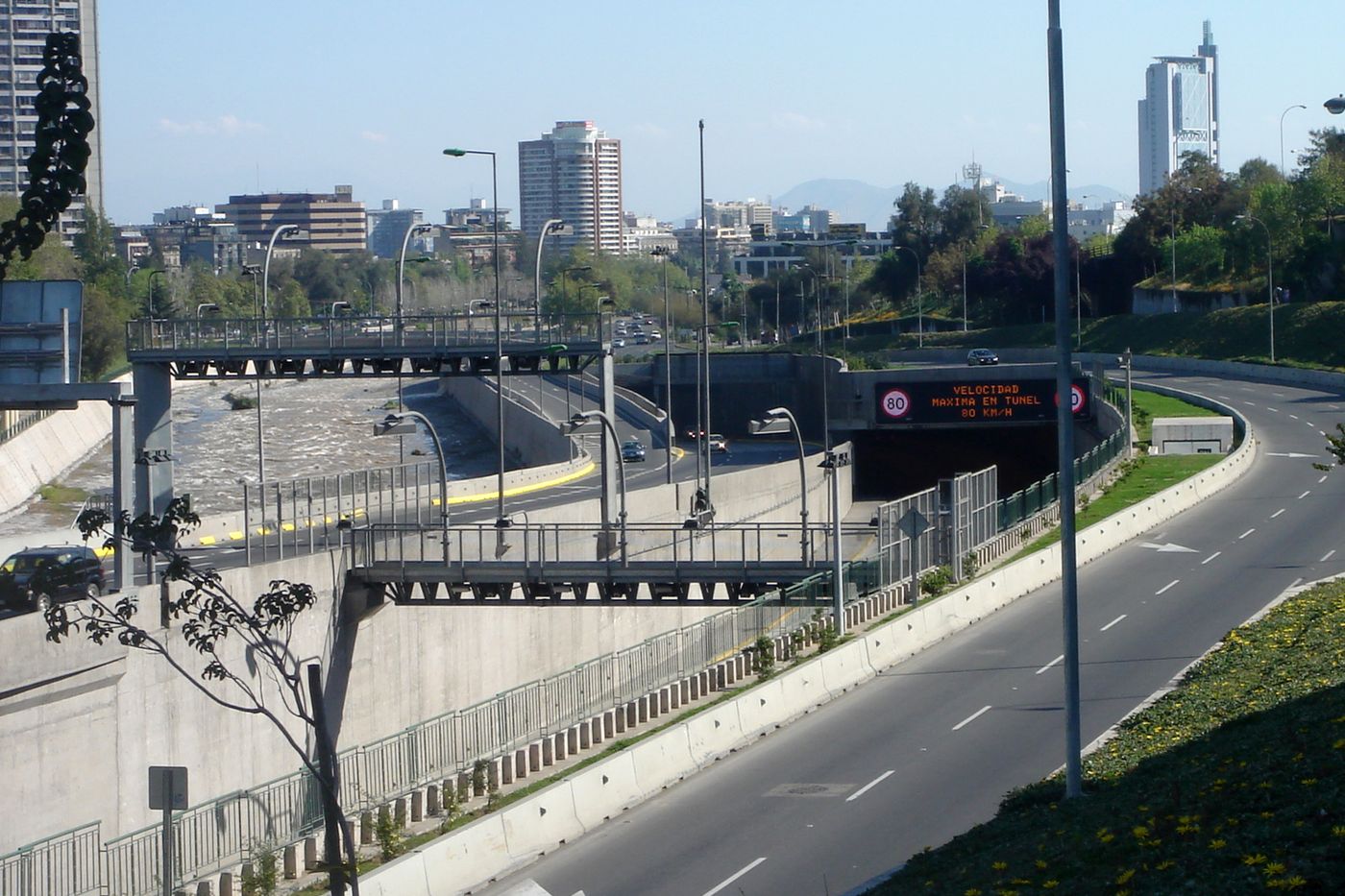
The route in. Taxis and ride-hails usually reach the center on the urban motorways, including the Costanera Norte, which runs along the Mapocho River through the city. Outside rush hour, the drive takes around half an hour; at the morning and evening peaks, plan on up to an hour.
When a private transfer is worth it
Private transfers cost the most, from roughly CLP 30,000 per vehicle in our airport guide’s September 2026 check, and for many arrivals they’re an unnecessary expense. They earn their price in a few situations:
- Arrivals between midnight and dawn, when you’d rather walk out to a named driver than queue at a counter or wait for a ride-hail.
- Families with small children, especially if you need a child seat, which you’ll have to request in advance.
- Travelers with limited mobility who need a suitable vehicle; our airport guide notes that accessible taxis are limited at SCL.
- Groups with a lot of luggage, such as ski bags or surfboards, which won’t fit in a standard taxi.
Book through your hotel or a reputable company, and confirm three things in writing: exactly where the driver will meet you, whether the price includes tolls and waiting time, and what happens if your flight is delayed. A good company tracks the flight and waits; a bad one leaves.
Ride-hailing from the airport
Ride-hail apps work at SCL and usually cost less than the official taxi counter, at roughly CLP 18,000-28,000 to the center in September 2026. Three things to know, in brief:
- Have data before you land, through an eSIM or the airport’s free wifi, so you can book from inside the terminal.
- Go to the designated pickup zone the app shows, not wherever a driver asks you to walk. Drivers sometimes ask passengers to meet them somewhere unofficial to avoid airport fees, which is how people end up on a service road with their luggage.
- Check the plate and the driver’s name before you get in.
At busy times, the wait for a car can erase much of the saving over the taxi counter. Our Santiago airport guide covers ride-hailing at SCL in more detail.
Timing: rush hour, late nights and early mornings
Rush hour. Santiago’s traffic peaks roughly 07:00-09:00 and 18:00-20:00, the same windows when the Metro charges its highest fare, CLP 895. A taxi that takes 30 minutes at 11:00 can take an hour at 08:30, and Line 1 is crushed at the same times. If you land into the morning rush with luggage, a car is still easier than the Metro, but it won’t be fast.
Late at night. The Metro closes at 23:00. If you land late, the bus-plus-Metro option ends with the Metro, so plan on an official taxi, a transfer or a ride-hail. Centropuerto advertises departures every 15 minutes every day; ask at its counter about the last bus if you’re arriving late and want to try it.
Early morning. On a weekday the Metro opens at 06:00, on Saturday at 06:30 and on Sundays and holidays at 07:30. If your flight lands before then, say at 05:00, the bus can take you to Pajaritos, Terminal Sur or República, but you’ll then wait for the Metro or take a taxi from there. The simplest plan at dawn is a taxi or private transfer straight to the hotel, and asking the hotel in advance about early check-in or bag storage.
Days of the week. Roads are typically quietest on Sunday mornings and busiest on Friday evenings.
Three arrivals, worked through
Real arrivals rarely look like the tidy options in a table. Here are three common ones, with what we’d do.
1. Solo, landing at 13:00 on a Wednesday, carry-on only, staying near the Plaza de Armas. Clear immigration and customs, follow the blue arrow, and buy a Centropuerto ticket (CLP 2,400) at the counter. Get off at Metro República, tap in with your contactless card, and ride Line 1 three stops east to Universidad de Chile (CLP 815 at the midday fare). Walk up Paseo Ahumada to your hotel. Total: about CLP 3,200 and roughly an hour from the bus stop at the airport to your door.
2. A couple, landing at 07:30 on a Tuesday with two large cases, staying in Lastarria. This is rush hour, the Metro will be packed, and the cases make the stairs hard work. Buy an official taxi at the counters behind the blue arrow, or book a ride-hail from inside the terminal, and go straight to the hotel. Expect the drive to take up to an hour in morning traffic, and the fare to land in the CLP 18,000-35,000 range depending on the option. Ask the hotel in advance about storing bags if your room isn’t ready.
3. A family of four, landing at 01:00, staying in Providencia. The Metro is closed, everyone is tired, and nobody wants to stand in a pickup zone. Book a private transfer before you fly, or buy an official taxi or transfer at the counters behind the blue arrow, making sure the vehicle can take four people and the luggage. The roads are empty at this hour, so the drive is usually quick.
The pattern: the bus is unbeatable for one person with light luggage in daylight; a car wins as soon as you add luggage, people, rush hour or darkness.
What the trip costs, for one, two or three people
| Option | One person | Two people | Three people |
|---|---|---|---|
| Centropuerto + Metro (off-peak) | About CLP 3,200 | About CLP 6,400 | About CLP 9,600 |
| Shared transfer van | CLP 8,000-12,000 | CLP 16,000-24,000 | CLP 24,000-36,000 |
| Ride-hail | CLP 18,000-28,000 | Same per car | Same per car, if the luggage fits |
| Official taxi | CLP 25,000-35,000 | Same per car | Same per car |
| Private transfer | From CLP 30,000 | Same per vehicle | Same per vehicle |
Bus fare CLP 2,400 plus the Metro’s CLP 815 valle fare, checked September-October 2026; other ranges from our airport guide’s September 2026 observations.
The table makes the trade-off clear. For one person, the bus saves roughly CLP 15,000-25,000 over a ride-hail. For three people with luggage, a single ride-hail costs two to three times as much as three bus-and-Metro journeys, but takes you to the door in one go, with no stairs. A useful middle path for two: the Centropuerto bus to Pajaritos or República, then a short ride-hail from there to the hotel, which skips the airport’s pickup premium and the Metro with luggage.
For a whole-trip budget, see what a trip to Santiago costs.
Your first hour: money, data and the Metro
A few practical things make the trip into the center smoother:
- Cash. You can pay for most things by card, including the official taxi counters and the Metro, which takes contactless Visa and Mastercard at the gates. Our airport guide notes ATMs in both terminals, with a foreign-card withdrawal fee of roughly CLP 3,500-5,500 shown on screen before you confirm (September 2026). Withdraw a useful amount once rather than several small amounts.
- Data. The airport has free wifi, adequate for booking a ride-hail or checking your route. An eSIM activated before you fly saves hunting for a SIM in the arrivals hall.
- The Metro. Contactless bank cards work at the gates, so you don’t need to buy anything for the Metro. If you’ll use the city’s red buses during your stay, you’ll need a bip! card, which costs CLP 1,550 with a minimum top-up of CLP 1,000 (checked September 2026); you can buy one later at a Metro station.
- The hotel address. Have it written down, including the comuna, the borough name such as Santiago, Providencia or Las Condes. Several Santiago streets share names across comunas, and the comuna tells a driver which one you mean.
Driving into the center
The airport lists car rental among its official ground transport, sold at the same counters behind the blue arrow. Driving from the airport into the center is straightforward on the urban motorways, but it rarely makes sense for a city stay. Santiago’s urban motorways use electronic tolling, so check with the rental company how tolls are charged on its cars; parking near hotels in the center and Lastarria is scarce and expensive; and the Metro, ride-hails and walking cover everything a first visit needs.
Rent a car only if you’re heading straight out of the city, to the coast, the wine valleys or the mountains, and if you do, consider picking it up at the airport on the day you leave Santiago rather than the day you arrive.
Arriving on a domestic flight
The blue-arrow transport center described above is part of the international arrivals exit. If you’re arriving on a domestic flight from elsewhere in Chile, the same broad choices apply: official taxis and transfers, the airport buses, ride-hail apps and car rental. Look for the official counters and signs in the domestic arrivals area, and apply the same rule as for international arrivals: if you didn’t pay at an official counter or book in an app, it isn’t the official service. Our Santiago airport guide explains how the two terminals work.
Scams and safety on arrival
Most arrivals at SCL are uneventful, and the new transport center behind the blue arrow has made the official choice easier to find. The risks that remain are the classic ones:
- Unofficial drivers in the public hall. They’ll offer a taxi before you reach the exit. Decline politely and keep walking; the official options are sold behind the blue arrow.
- Decimal tricks on card payments. The UK government’s example of a CLP 5,000,000 charge instead of CLP 50,000 is the extreme version. Read the amount on the card machine before you tap or enter a PIN.
- Luggage theft. The UK government warns of theft at the terminal and from the carousel. Keep your bags in sight and in contact, especially while you’re distracted by a phone or a ticket counter.
- Distraction. The Government of Canada lists airports among the places where petty crime happens in Chile (checked September 2026). Someone spilling something on you, or asking for help, while an accomplice takes a bag is a known trick.
- Pickup confusion. With a ride-hail, check the plate and name before you get in, and never get into a car that isn’t the one in the app.
Our Santiago safety guide covers the scams you might meet in the city itself.
Accessibility and assistance
The airport operator runs a free mobility assistance service for passengers with limited mobility, including permanent or temporary physical disabilities, older travelers and people with sensory difficulties (checked 1 October 2026). Staff accompany you, with a wheelchair or an electric cart, from the arrival gate to the public area on arrival, and from a meeting point to the boarding gate on departure.
How to use it:
- Book at least 48 hours ahead through the operator’s Purple Door app or its website; you can book up to a week in advance.
- Tell your airline as well. The operator asks passengers to inform the airline of the request too.
- On arrival, your assistant meets you at the arrival gate; you can share your location through the app.
- Questions: the mobility assistance line is +56 2 2690 1757.
For the onward journey, our airport guide notes that accessible taxis are limited, so a private transfer with a suitable vehicle booked in advance is the dependable option. The Centropuerto buses are coaches with steps, and while the Metro has lifts at many stations, step-free access varies by station and entrance, so check before relying on it. Our guide to accessible Santiago covers transport in the city.
Getting back to the airport from the center
Everything above works in reverse, with a few differences:
- By bus. Centropuerto sells tickets to the airport from Metro República, Terminal Sur and Pajaritos, with departures every 15 minutes (checked 1 October 2026). Leave plenty of margin; a bus caught in traffic is still a bus caught in traffic.
- By taxi or ride-hail. Book a ride-hail or have your hotel call a taxi. Our airport guide puts the run from the center at around 25 minutes before 06:30, and much longer at rush hour.
- By shared transfer van. Vans can be booked for the return, usually through your hotel or the transfer company. Pickups follow a route around several hotels, so ask what the pickup window is and choose an earlier slot than you think you need.
- When to leave. For international flights, aim to be at the airport about three hours before departure, and add an hour of traffic margin if you’re leaving the center between 07:00 and 09:00 or 18:00 and 20:00.
Our Santiago airport guide covers check-in, terminals and departure timings in detail.
Which option should you choose?
A simple decision guide:
- Solo, daytime, carry-on only: Centropuerto to República or Terminal Sur, then Line 1. About CLP 3,200 all in.
- Solo, late or tired, with a big case: shared transfer van or ride-hail.
- Two people, daytime: bus to Pajaritos or República plus a short ride-hail, or a ride-hail all the way.
- Three or more, or a family: ride-hail or official taxi from the counters behind the blue arrow, or a private transfer booked ahead.
- Arriving before 06:00: official taxi or private transfer; the Metro won’t be running yet.
- Limited mobility: book the airport’s free assistance 48 hours ahead and a private transfer with a suitable vehicle.
- Heading straight out of the city: rent a car at the airport counters and skip the center altogether.
Whatever you choose, buy it behind the blue arrow or in the app, and ignore everything else. For everything that happens before and after this ride, from the terminals to SIM cards and the departures process, see the full guide to Santiago airport.
A checklist before you land
- Decide by arrival time. Daylight and light bags: the bus. Rush hour, darkness, heavy bags or a group: a car.
- Know the blue arrow. Official transport is sold at the counters behind it, after customs and before the public hall.
- Have data, from an eSIM or the airport wifi, if you plan to use a ride-hail app.
- Write down the hotel address with its comuna, for the driver or for your own navigation.
- Fill in the customs and SAG declaration honestly, declaring all food, plant and animal products.
- Book ahead if you need to: mobility assistance at least 48 hours before your flight, and a private transfer for very late arrivals.
- Tipping. Taxi drivers in Chile don’t generally expect a tip, though rounding up is appreciated; with ride-hail apps, any tip goes through the app.
Frequently asked questions
How do I get from Santiago airport to the city center?
The cheapest way is the Centropuerto bus, CLP 2,400 one way, every 15 minutes, to Metro República, Terminal Sur or Pajaritos on Line 1, then the Metro (checked 1 October 2026). Official taxis from the counters after customs cost roughly CLP 25,000-35,000, and ride-hails roughly CLP 18,000-28,000.
How much is the bus from Santiago airport to downtown?
Centropuerto charges CLP 2,400 one way and CLP 4,100 return, with e-tickets valid for 90 days, according to its site on 1 October 2026. Add a Metro fare of CLP 735-895 to reach your stop in the center. TurBus Aeropuerto is the other official airport bus.
How long does it take from Santiago airport to the city center?
About 30 minutes by taxi or ride-hail outside rush hour and up to an hour at the 07:00-09:00 and 18:00-20:00 peaks. By bus and Metro, allow 45 to 75 minutes door to door, including the change and the walk at the far end.
Where are the official taxis at Santiago airport?
In the new transport center for international arrivals. After the SAG and customs hall, follow the blue arrow on the floor to the official counters, where you can buy basic or tourism taxis, transfers and bus tickets before entering the public hall. Anyone offering a ride in the public hall isn’t official.
Is the Centropuerto bus safe and easy with luggage?
The bus is safe and has a luggage hold, so it’s easy. The harder part is the Metro afterward, with stairs at some entrances and crowded trains at rush hour. With a carry-on it’s fine; with large cases, consider a taxi or a bus-plus-ride-hail combination.
Can I take the Metro from Santiago airport?
Not directly; the Metro doesn’t reach the airport. Take the Centropuerto bus to Pajaritos, Terminal Sur or República, all on Metro Line 1, and continue by Metro. The Metro runs 06:00-23:00 on weekdays, from 06:30 on Saturdays and from 07:30 on Sundays and holidays.
What should I do if I land after midnight?
Buy an official taxi or transfer at the counters behind the blue arrow, or book a ride-hail from inside the terminal. The Metro closes at 23:00, so the bus-plus-Metro option doesn’t work late at night. Ask at the Centropuerto counter about late buses if you want to try.
Does Santiago airport have help for passengers with reduced mobility?
Yes. The airport operator offers free mobility assistance, with a wheelchair or electric cart, from the arrival gate to the public area on arrival. Book at least 48 hours ahead through its Purple Door app or website, tell your airline, and call +56 2 2690 1757 with questions.
Sources
- Aeropuerto Santiago de Chile: official transport
- Aeropuerto Santiago de Chile: buses to and from the airport
- Aeropuerto Santiago de Chile: official taxis
- Aeropuerto Santiago de Chile: mobility assistance
- Centropuerto: airport bus routes and fares
- Turbus
- Metro de Santiago: fares and hours
- Metro de Santiago: contactless payment
- UK FCDO: Chile safety and security
- UK FCDO: Chile entry requirements
- Government of Canada: travel advice for Chile
- Servicio de Impuestos Internos: dólar observado 2026
Image credits
| Photo | Credit |
|---|---|
| Santiago airport apron (top of page) | Christer T Johansson, CC BY 3.0, via Wikimedia Commons |
| Estación Central | AlBustos, CC BY-SA 3.0, via Wikimedia Commons |
| SCL terminal hall | Marcelo Páez Bermúdez, CC BY 2.0, via Wikimedia Commons |
| Terminal Alameda | Carlos yo, CC BY-SA 3.0, via Wikimedia Commons |
| Palacio de La Moneda | Marcelo Ois Lagarde, CC BY-SA 3.0, via Wikimedia Commons |
| Costanera Norte | Mario Roberto Duran Ortiz, CC BY-SA 3.0, via Wikimedia Commons |
| Metro Los Héroes | Paul Lowry, CC BY 2.0, via Wikimedia Commons |
| The Alameda | Alstradiaan, CC BY-SA 3.0, via Wikimedia Commons |