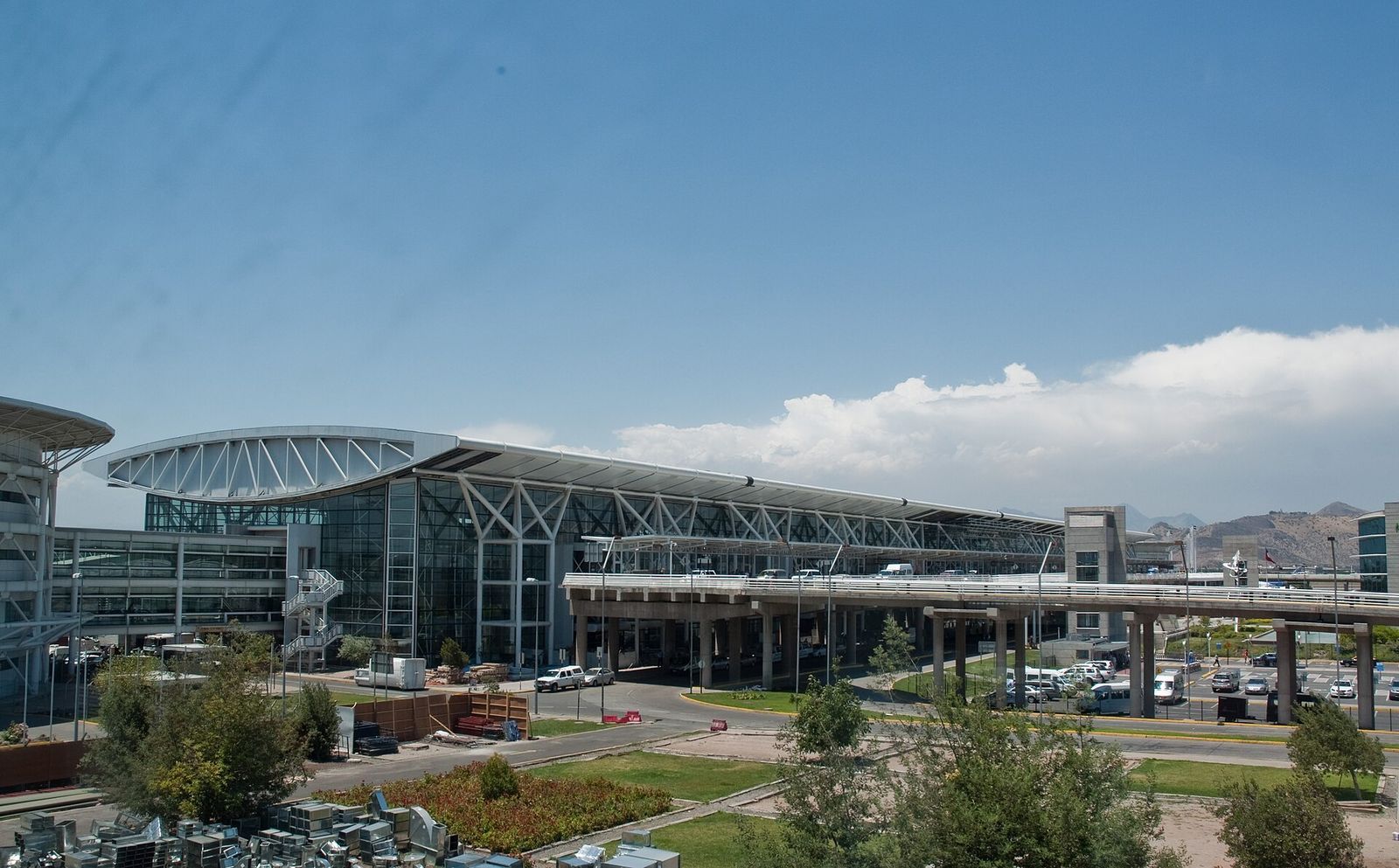
This Santiago Chile airport guide covers the one hour that decides how your trip starts: clearing immigration at Arturo Merino Benítez, ignoring the people who approach you in arrivals, and choosing between a CLP 2,400 bus and a CLP 30,000 taxi. Terminals, counters, costs and scams, checked September 2026.
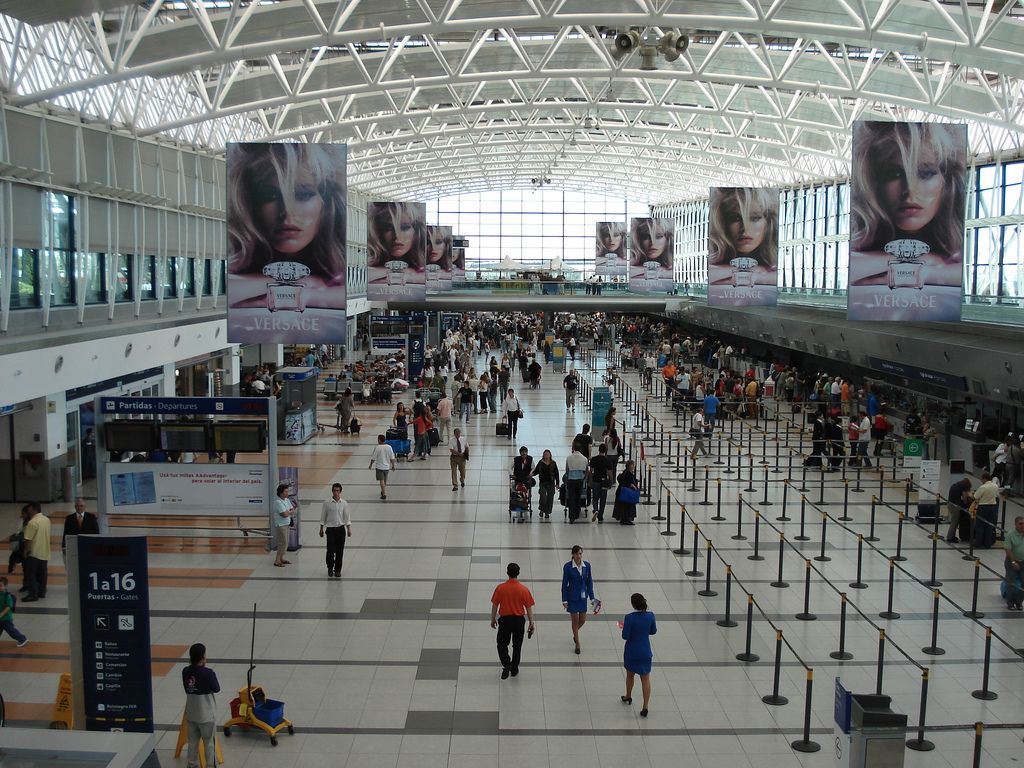
Arturo Merino Benítez (SCL), run by the Nuevo Pudahuel concession, sits 17 km northwest of the city center in the comuna of Pudahuel. It is the busiest airport in Chile and the main South American hub for LATAM, and since the second terminal opened it has been a genuinely comfortable airport rather than the overloaded one it was for years. The journey into town takes 30 minutes at dawn and well over an hour in Friday evening traffic.
The 60-second arrival plan
If you read nothing else on this page, read this.
- Fill in the customs and SAG declaration on the plane. Declare every food, plant and animal product you are carrying, including the apple from the flight.
- Clear immigration and keep the white tourist card you are handed. Photograph it immediately. You need it to leave the country and to claim the hotel IVA exemption.
- Collect bags, clear the SAG scanner. All baggage goes through an agricultural x-ray, and the dogs work the hall.
- Walk past everyone who approaches you. Anyone offering a taxi or a transfer in the arrivals hall before you reach a counter is not the official service.
- Choose one of three things: the bus if you are on a budget and not exhausted, the official taxi counter if you want simple and fixed, the ride-hail app if you want cheaper than a taxi and can find the pickup area.
- Pay in pesos. Decline any offer to charge your card in dollars.
What happens before you reach the arrivals hall
Chilean entry is straightforward and the queues are the only real variable. Immigration processes most flights quickly, but three or four wide-bodies landing together in the early morning can produce a 45-minute wait, which matters if you have a domestic connection.
Immigration. Citizens of the US, UK, Canada, Australia, New Zealand and the EU need no visa and get up to 90 days. Your passport must be valid past your departure date. You will be handed the Tarjeta Única Migratoria, the A5 white slip, and this is the single most commonly lost document in Chilean travel. If you lose it, the PDI issues a replacement online or at an office, but not at 05:00 on the morning of your flight home.
SAG. Chile’s agricultural inspection is genuinely strict, because the Atacama, the Andes and the Pacific make the country a phytosanitary island worth protecting. No fresh fruit, seeds, honey, raw nuts, meat or dairy. Declared items are confiscated at no cost; undeclared items found in your bag draw a fine. Every checked and carry-on bag passes an x-ray after baggage claim.
Connections. If you are transferring to a domestic flight, allow more time than the minimum connection: you clear immigration, collect bags, pass SAG, and re-check for the domestic leg.
One more timing note. Long-haul flights from Europe and North America overwhelmingly land between 05:00 and 09:00, which is why the immigration hall can be empty at 14:00 and forty minutes deep at 07:00. If you have any flexibility over which flight you book, a mid-afternoon arrival gets you through the airport faster and into a city that is still awake when you reach your hotel.
Terminal 1 and Terminal 2
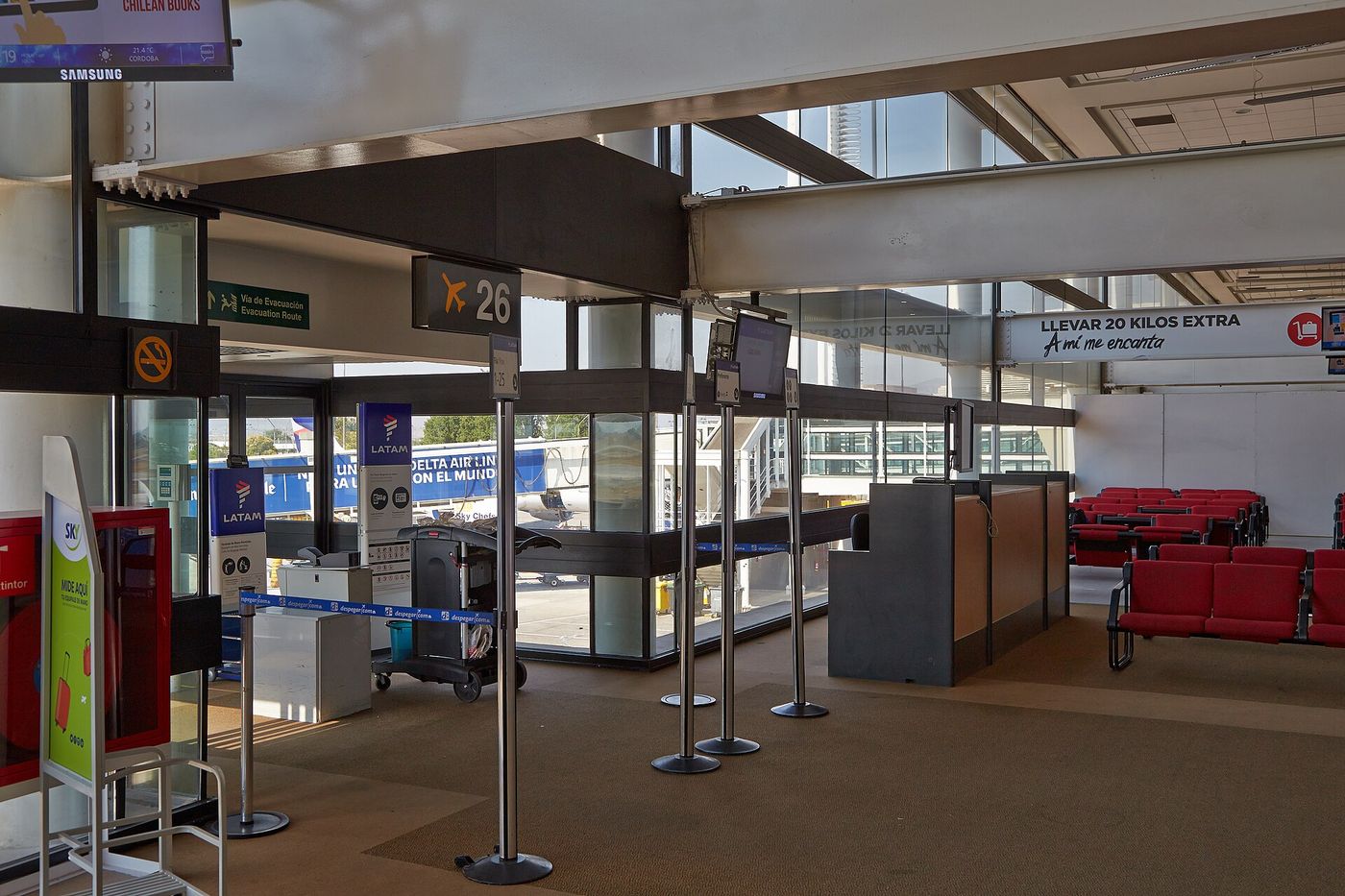
SCL has two connected passenger terminals. Terminal 2, the large newer building, handles international flights. Terminal 1, the original terminal, handles domestic flights. They sit side by side and are connected on foot, with a walk of roughly five to ten minutes between them depending on where you start.
That layout produces the airport’s one persistent piece of confusion: arriving internationally and connecting domestically means changing buildings, and meeting someone off a domestic flight means going to T1, not the shiny one. Signage is clear and bilingual, and there are staff in the connecting area, but allow the ten minutes.
Both terminals have the usual services. Ground transport counters, car rental desks, ATMs and exchange bureaux are in the arrivals areas; the larger food and retail offering is in T2, airside and landside.
Left luggage. There is paid baggage storage landside, which is what makes a layover trip into the city practical. Rates are charged per item per block of hours and are not cheap, but they are less than the cost of dragging two suitcases around the Plaza de Armas.
Meeting someone. Arrivals in Terminal 2 has a designated meeting area outside customs, and it gets crowded during the morning wave. If you are meeting a Chilean family member, expect a crowd; if you are meeting a driver, expect a name board. The short-stay car park is expensive enough that most locals circle instead, so a pickup often means a phone call and a specific door number rather than someone waiting inside.
How do you get from Santiago airport to the city?
Four ways. The Centropuerto airport bus to Metro República, Terminal Sur, Pajaritos or Maipú costs CLP 2,400 one way and takes 40-60 minutes with a Metro connection. Official taxis booked at an indoor counter run about CLP 25,000-35,000. Ride-hailing is usually CLP 18,000-28,000. Shared transfer minibuses fall in between at around CLP 8,000-12,000 per person.
| Option | Typical cost | Door to door | Best for | Catch |
|---|---|---|---|---|
| Airport bus + Metro | CLP 2,400 + Metro fare | 60-90 min | Budget, daytime, light luggage | Two changes with bags |
| RED public bus | Standard RED fare | 60-90 min | The cheapest option | Needs a bip! card, not a bank card |
| Shared transfer minibus | CLP 8,000-12,000 pp | 45-80 min | Two or three people, hotel door | Waits to fill; multiple drop-offs |
| Ride-hailing | CLP 18,000-28,000 | 30-60 min | Most travelers | Finding the designated pickup zone |
| Official taxi | CLP 25,000-35,000 | 30-60 min | Late arrivals, no phone signal | Most expensive of the sensible options |
| Private transfer | CLP 30,000-60,000 | 30-60 min | Families, business, red-eyes | Book before you fly |
Those are typical fares observed in September 2026 at roughly CLP 950 to USD 1. Airport fares are posted at the counters and the posted price governs; treat the numbers above as a sanity check rather than a quote.
The buses: Centropuerto, Turbus and RED
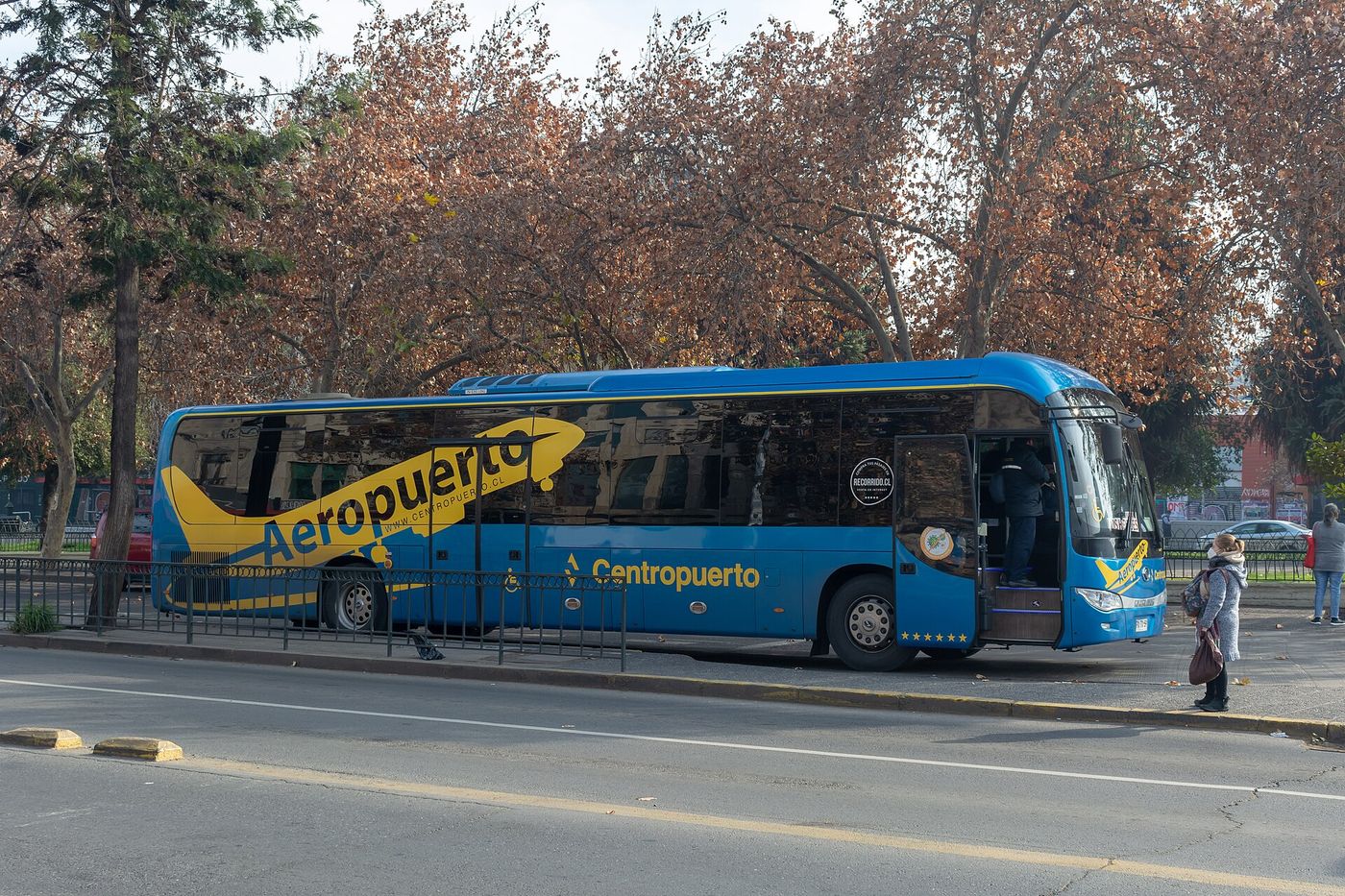
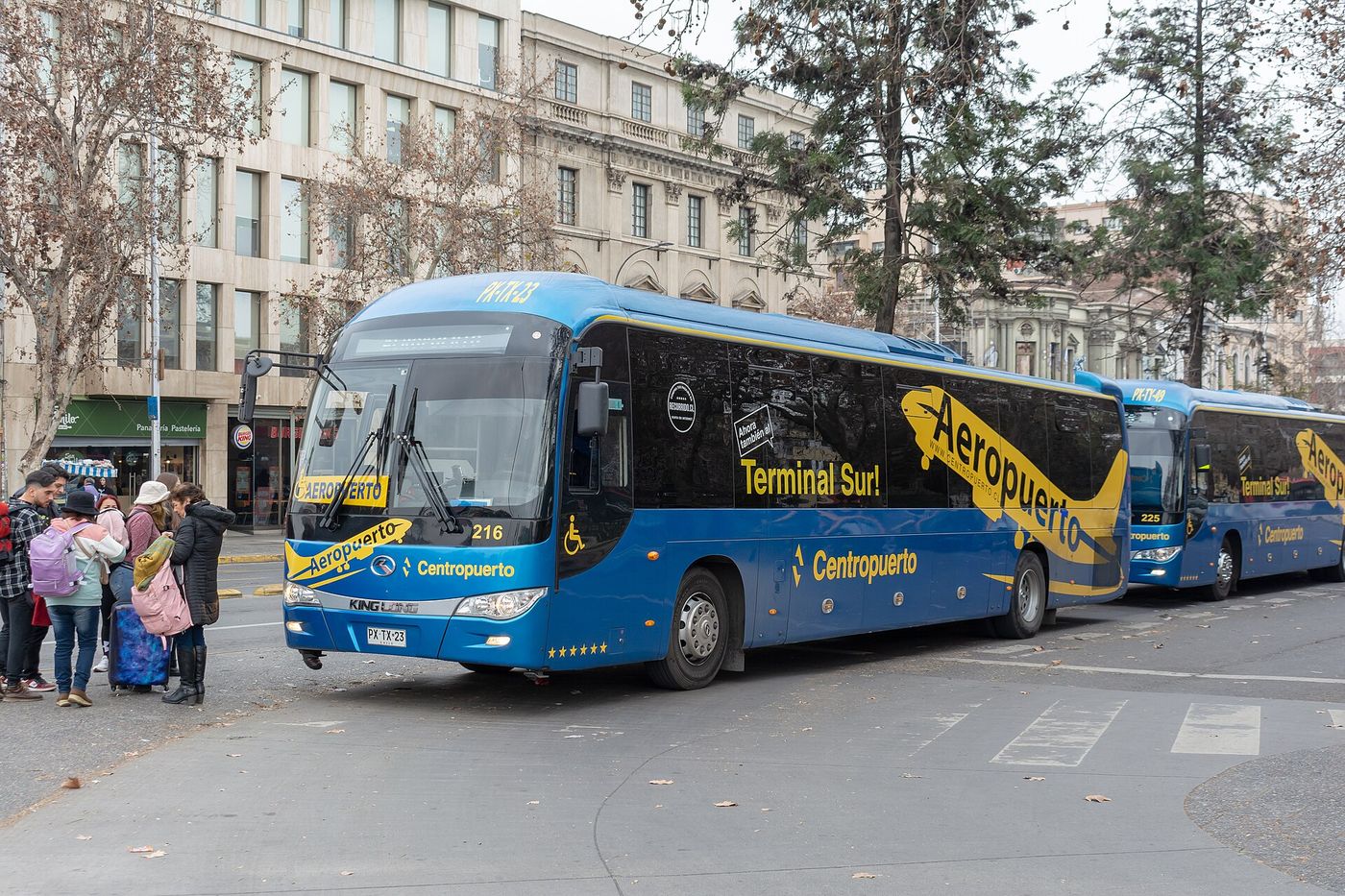
Two dedicated airport bus operators, Centropuerto and Turbus Aeropuerto, run frequently from just outside the arrivals level, with clearly marked stops and staff selling tickets at the kerb and at small counters inside. Centropuerto lists departures every 15 minutes, every day, at CLP 2,400 one way or CLP 4,100 return (checked 1 October 2026); for Turbus Aeropuerto’s stops and fares, ask at its counter.
Centropuerto lists four routes into the city: Metro República, Terminal Sur, Pajaritos and Maipú. The first three are on Metro Line 1, and two of them matter most:
- Terminal Pajaritos, an intermodal station directly on Metro Line 1. This is the better option for anywhere east of the centro: Providencia, Las Condes, Ñuñoa. The connection is signposted and takes a couple of minutes.
- Metro República, the stop closest to the centro, also on Line 1, which is the better option for the historic center, Lastarria and Barrio Brasil. Terminal Sur, in the cluster of bus terminals at Estación Central, sits between the two.
A third option is the RED public bus network, the city’s ordinary bus system, which runs a service connecting the airport with the city. It is the cheapest way in, at a standard RED fare rather than an airport premium. The constraint is payment: RED buses do not take contactless bank cards, so you need a bip! card, which you cannot reliably buy at the airport. That makes it a good option for a returning visitor with a bip! in their wallet and a poor one for a first arrival.
The honest verdict on buses. They are excellent value and a perfectly civilised way into the city at 11:00 on a Tuesday with a carry-on. After a ten-hour overnight flight, with two large cases and a hotel in Lastarria, the bus-plus-Metro combination involves stairs, crowds and a walk at the far end, and the CLP 20,000 you save is not worth it.
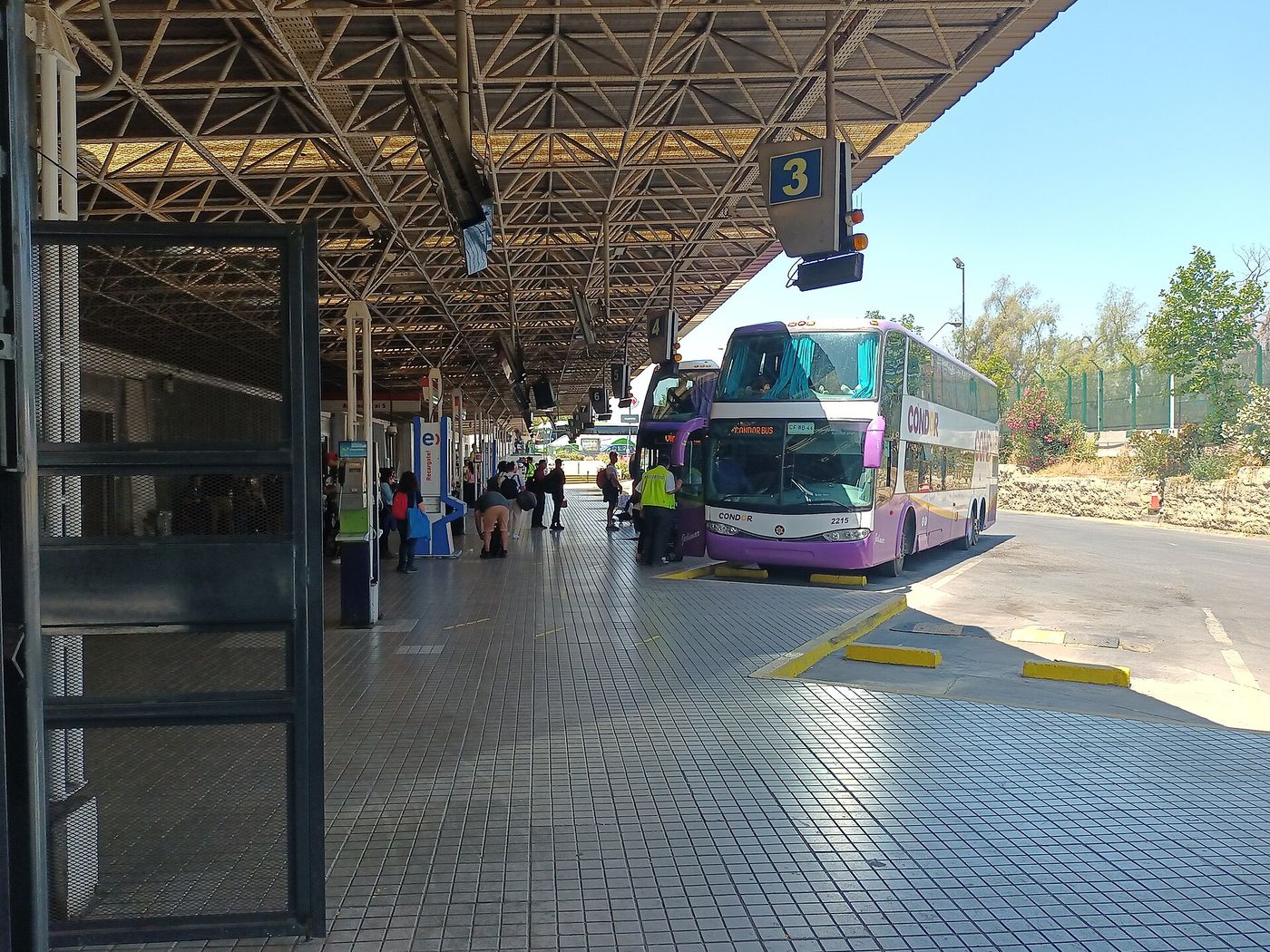
Which bus stop, and what it looks like. The airport buses pick up on the departures or arrivals kerb depending on operator, with branded stands and staff in company jackets. You can buy a ticket from the driver or at the stand. Luggage goes in the hold and there is no extra charge for it. The buses are coaches rather than minibuses, with proper luggage space, which is the main difference between them and the RED city buses.
What the journey is actually like. Airport to Pajaritos takes 20-30 minutes outside peak. At Pajaritos you walk from the bus platforms into the Metro station, tap in, and ride Line 1 east. From the airport to a hotel in Providencia, door to door with a bag, budget 75-90 minutes and one flight of stairs. From the airport to Metro República for the centro, budget 45-60 minutes plus a short Metro ride or walk at the far end.
A useful pairing. If there are two of you with luggage, the bus to Pajaritos followed by a short ride-hail from Pajaritos to your hotel is often the best value of all: it skips the expensive airport pickup fee and the long Metro leg with cases, and the total lands well under a counter taxi.
Official taxis: how the counter system works
Santiago airport uses a prepaid counter system, and understanding it is the single most useful thing in this guide. For international arrivals, the official counters for taxis, transfers and buses are now in a transport center, a secure area before the public hall: after the SAG and customs hall, follow the blue arrow on the floor. Our guide to getting from the airport to the city center walks through each option.
You walk to a staffed counter, tell them your destination, pay a fixed zone-based fare, and receive a ticket. A dispatcher then walks you to a vehicle at an official rank. You do not negotiate with a driver, there is no meter, and the price does not change in traffic.
The operators change over time as concessions are retendered, so rather than memorizing a company name, use the rule: if you did not pay at a counter inside the building, it is not the official service.
Typical zone fares in September 2026 ran roughly CLP 25,000-35,000 (about USD 26-37) to the centro, Providencia and Las Condes, with Vitacura and the far east of the city at the upper end. The fare is posted at the counter before you pay.
Why the counter is worth its premium. Late at night, with no local SIM, no Spanish and a sleeping child, a fixed price and a dispatcher who writes down the plate number is a reasonable thing to buy. On a Tuesday afternoon with a working phone, it is not.
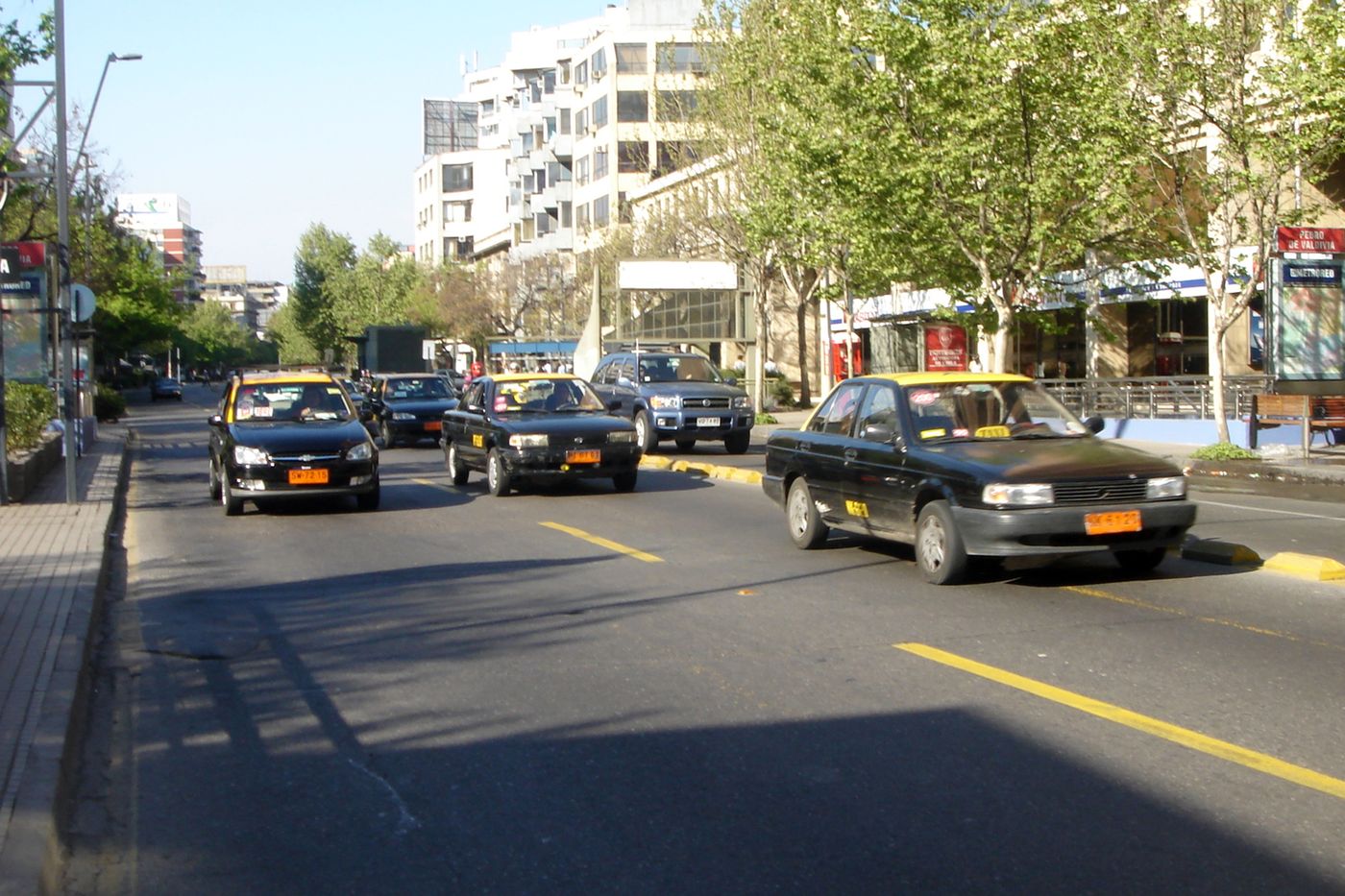
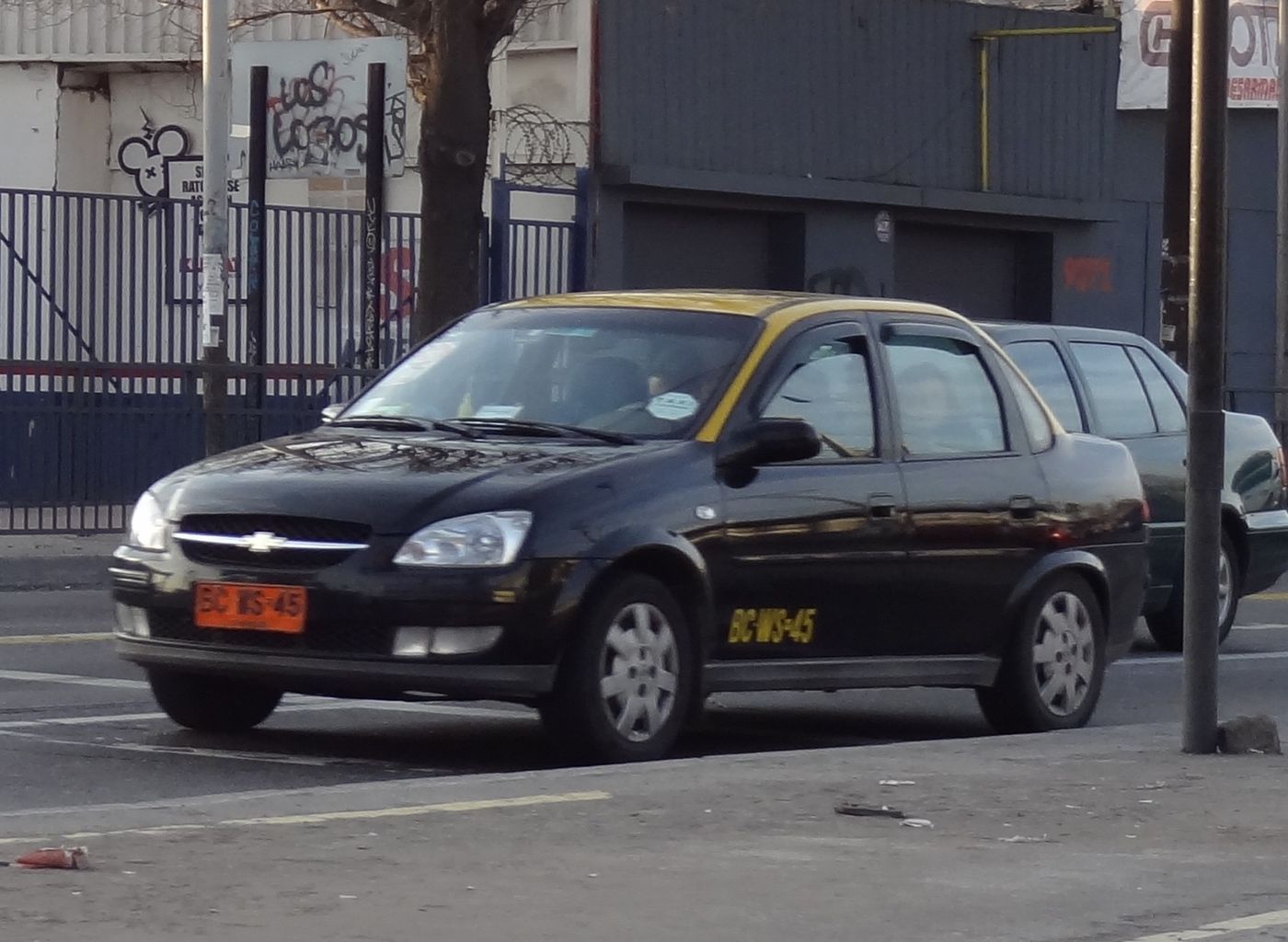
A note on the black-and-yellow taxis outside. Ordinary Santiago street taxis, black with a yellow roof, are metered and generally honest in the city. At the airport, though, the only ones permitted to pick up are those in the official concession, and the metered street taxi that offers you a ride in the forecourt is operating outside the system. The fare may well be fine. The recourse if it is not, however, is nothing, which is the whole point of the counter.
Ride-hailing at SCL
Ride-hailing apps operate at Santiago airport and are usually 20-35% cheaper than the official taxi counter. The friction is the pickup point: apps are directed to a designated zone rather than the kerb outside arrivals, and that zone has moved more than once as the airport has reorganized its forecourt.
What to do:
- Have data before you land. Either an eSIM activated in the air or the airport wifi, which is free and adequate for hailing a car.
- Follow the app’s walking directions, not a driver’s phone call. Drivers occasionally ask passengers to walk somewhere unofficial to avoid the airport’s fees. That is how people end up standing on a service road with luggage.
- Check the plate before you get in, every time.
- Expect a surcharge. Airport pickups carry a fee that the app includes in the quote.
At peak arrival times the wait for a car can run 10-20 minutes, which erases some of the saving over the taxi counter.
Paying. Cards work everywhere at the airport, including at the taxi counters and on the airport buses. There is no need to arrive with pesos in hand, though having a few thousand for a coffee or a kiosk saves a queue at the ATM when you are tired.
Shared and private transfers
The minibus transfer companies with desks in arrivals sell two products. A shared transfer puts you in a van with other passengers heading to hotels in the same general area, at around CLP 8,000-12,000 per person; you wait for the van to fill and you may be the fourth drop-off. A private transfer gives you the whole vehicle, door to door, from roughly CLP 30,000.
Private transfers booked in advance online are worth it in three situations: a family with children and car seats, a group of four or more where the per-head cost undercuts two taxis, and any arrival between 23:00 and 06:00 when you want a name board rather than a decision.
For everyone else they are a convenience purchase. There is nothing wrong with buying convenience after a long flight; just know that is what you are buying.
Groups of five or more. Once you are past four people with luggage, the arithmetic changes again: a private van transfer booked in advance often costs less than two taxis and is far less trouble than splitting a group across vehicles that arrive separately. This is the one case where the pre-booked transfer is clearly the cheapest option rather than the comfortable one.
Renting a car at the airport
All the major international rental companies and several Chilean operators have desks in the arrivals areas. Renting at the airport makes sense if you are heading straight out to the wine valleys, the coast or the Andes, and very little sense if you are spending your first days in Santiago, where parking is expensive and the Metro is faster.
Three Chilean specifics:
- Tolls are electronic. Urban highways and most intercity routes use TAG transponders, which the rental company supplies and bills afterwards. Ask how it is charged rather than assuming it is included.
- The drink-driving limit is close to zero and enforced with roadside breath tests, especially at weekends on the routes back from the wine valleys.
- Crossing into Argentina requires specific paperwork from the rental company, arranged days in advance, and a fee. You cannot decide to do it on the morning.
How much should the airport taxi cost?
Budget CLP 25,000-35,000 (about USD 26-37) from SCL to the centro, Providencia or Las Condes with an official prepaid taxi, and CLP 18,000-28,000 with a ride-hailing app. Shared minibus transfers run CLP 8,000-12,000 per person. Anything quoted in US dollars, or quoted by someone who approached you, is not the official price.
A few things that legitimately move the price: the far eastern comunas, Vitacura and parts of Las Condes, sit in a higher zone; very late arrivals can carry a surcharge; and a vehicle large enough for four people with four suitcases is a different product from a saloon.
What should not move the price: traffic, on a prepaid fixed fare. If a driver from a counter-booked taxi tells you the fare has gone up because of congestion, that is not how the system works.
Where the rental desks are, and the overnight catch. The desks sit in the arrivals areas of both terminals, and most of the major operators keep their vehicles in a nearby car park reached by a short shuttle rather than at the terminal itself. That adds 15-20 minutes to the collection process, which matters if you are landing late: several desks close overnight even when the airport is busy, so confirm the opening hours against your actual arrival time rather than your scheduled one.
The arrivals hall: touts, scams and what to ignore
Santiago’s arrivals hall is not dangerous. It is, however, full of people whose business model is intercepting tired travelers before they reach an official counter, and the consistent advice from consular guidance is to book transport at a counter rather than accepting an approach.
The recurring patterns:
- The friendly helper with a lanyard. A lanyard is not accreditation. Official taxi staff work at fixed counters and official ranks, not roaming the hall.
- “The bus is not running today.” It is.
- Dollar quoting. A price quoted in USD to an arriving foreigner is a marker of an unofficial operator.
- The card machine that offers to charge in your home currency. Dynamic currency conversion costs 3-7%. Always choose pesos.
- Distraction at the ATM. The classic pairing is someone talking to you while someone else watches your PIN. Use the ATMs inside the terminal, not the ones in quieter corners.
None of this is unique to Santiago, and none of it justifies being nervous. Walk to a counter, pay in pesos, check the plate.
One last piece of arrivals-hall geography. The official counters sit inside the building, before the automatic doors to the forecourt. Once you walk out of those doors you are in the open ground-transport area, which is where the unofficial approaches concentrate. The simple version of every warning above: make your transport decision before you walk outside.
Money, SIM cards and wifi at the airport
ATMs. There are bank ATMs in both terminals. Expect a foreign-card withdrawal fee of roughly CLP 3,500-5,500, disclosed on screen before you confirm. Withdraw a useful amount at once rather than making several small withdrawals. Airport ATMs sometimes run dry late at night on busy weekends.
Exchange. The casas de cambio in the terminal give noticeably worse rates than those on Agustinas in the centro. Change a small amount for the bus and a coffee, not your budget.
SIM cards. Entel, Movistar, Claro and WOM all sell prepaid tourist SIMs, and Chilean law requires passport registration, which takes a few minutes at a counter. An eSIM bought before you fly avoids the queue entirely and works on the same networks. Coverage in the city is excellent.
Wifi. Free airport wifi is available in both terminals and is good enough to hail a car or message a hotel.
Eating, lounges and sleeping at SCL
The food offer in Terminal 2 is decent by regional standards, both landside and airside, with the usual span from fast food to a sit-down restaurant, and prices roughly double what the same meal costs in the city. There is a small supermarket presence for anyone stocking up before a long domestic flight.
Lounges are available in T2 for premium cabins, airline status holders and the main independent access programs, with paid entry generally available if there is space. They are fine rather than remarkable.
Sleeping. There is hotel accommodation immediately at and around the airport, aimed at transiting business travelers, with 24-hour shuttles. It is worth booking only for a flight before 06:30 or an arrival after midnight with onward travel the same morning. For any other schedule, stay in the city and take a taxi at dawn; the roads are clear before 06:00 and the trip takes 25 minutes. The trade-offs by neighborhood are covered in where to stay in Santiago.
Overnighting inside the terminal. SCL is open through the night and people do sleep in it, but it is not a comfortable airport to do that in: seating is mostly armrest-divided, the airside food offer thins out after midnight, and the cleaning crews work through. If your connection is eight hours or more overnight, one of the airport hotels with a shuttle is worth the money. If it is five or six, the departures level in Terminal 2 is bright, safe and busy enough that the hours pass.
Is Santiago airport good for a long layover?
Yes, for six hours or more. Immigration is quick, luggage storage exists landside, and the centro is 30-45 minutes away by bus and Metro, which gives a six-hour layover roughly two hours in the city. Under five hours, stay in the terminal. Over ten, you can add Cerro Santa Lucía and a real lunch.
The practical shape of a layover run: clear immigration, store bags, take the Centropuerto bus to Pajaritos, Metro Line 1 to Universidad de Chile, walk the Plaza de Armas and Paseo Ahumada, eat, and turn back with a full hour of buffer. Do not attempt Cerro San Cristóbal, where a weekend funicular queue can swallow 40 minutes on its own.
Two warnings. The baggage hall is slower than immigration, and an airline’s published minimum connection time is a legal minimum rather than a realistic plan. And on 18 and 19 September, Fiestas Patrias, the roads in and out of the city are the worst of the year.
Detailed timings for both the six-hour and twelve-hour versions are in our Santiago itineraries.
Getting to the airport from the city. Everything above works in reverse, with the timings slightly different. Centropuerto’s buses pick up at Metro República, Terminal Sur, Pajaritos and Maipú, with departures every 15 minutes. A ride-hail or taxi from Providencia takes 25 minutes before 06:30 and 45-70 minutes between 07:00 and 09:30 or 17:00 and 20:00, which is the window in which people miss flights. If your flight leaves between 09:00 and 12:00, leave an hour earlier than the distance suggests.
Accessibility and assistance at SCL
Santiago airport provides mobility assistance on request, and the reliable way to arrange it is through your airline at booking, ideally at least 48 hours before departure. That request is what triggers assistance at both ends of the flight. On the day, present yourself at your airline’s check-in desk or, on arrival, stay in your seat until the assistance team boards.
What the airport provides:
- Step-free access throughout both terminals, with lifts and ramps.
- Accessible toilets in all main areas.
- Wheelchair assistance from kerb to gate and gate to kerb.
- Priority lanes at security and immigration for passengers with reduced mobility.
- Assistance for passengers with visual, hearing or cognitive disabilities, including hidden-disability lanyard schemes of the kind now common internationally.
Two Chilean specifics worth knowing. Accessible taxis are limited, so a private transfer booked in advance with a suitable vehicle is the dependable option rather than turning up and hoping. And the Metro is largely accessible with lifts at most stations, but a handful of older Line 1 stations still have gaps, so check the specific station before you plan a step-free route from Pajaritos.
Flying on within Chile
Chile is 4,300 km long, so a great many visitors take a domestic flight after Santiago, and the airport handles that badly if you do not plan for it.
Domestic departures leave from Terminal 1, a separate building from international arrivals, and the connection is not airside: you clear immigration, collect your checked bags, pass the SAG x-ray, walk to T1 and check in again. Allow three hours between an international arrival and a domestic departure, and more if you are landing in the morning wave.
Three further points. Domestic carriers in Chile run aggressive hand-luggage policies with paid bags as the norm, so the fare you compared online may not be the fare you pay at the desk. Domestic flights to Patagonia are weather-sensitive and cancellations are not unusual in winter. And if you are flying to Easter Island, that is technically a domestic flight with extra requirements, including a completed entry form and proof of accommodation, which are checked at the gate in Santiago rather than on arrival.
Departures: how early, and what to expect
Arrive three hours before an international departure and two hours before a domestic one. Those are the airline recommendations and they are realistic at SCL, where the early-morning and late-evening waves both produce long check-in lines.
The departures process is conventional: check-in, security, immigration for international flights, gate. Liquids and electronics rules follow international norms. The airport is large enough that the walk to a distant gate can take fifteen minutes.
Three departure-specific points:
- Hand over the tourist card at immigration on the way out. If you have lost it, allow extra time to sort it at the PDI desk.
- Tax-free shopping exists for departing travelers in the airside retail area; the discount is real on spirits and cosmetics and unremarkable on everything else.
- Domestic flights leave from Terminal 1, so if you are being dropped off, say which terminal.
For getting to the airport from the city, the same options run in reverse, with one addition: Centropuerto’s buses pick up at Metro República, Terminal Sur, Pajaritos and Maipú every 15 minutes, and from the centro at dawn a taxi is only 25 minutes. For the Metro and bus system generally, see the Santiago travel guide.
Arriving with children, and arriving at 03:00
With children. The official taxi counter or a pre-booked private transfer with car seats is worth the money. Chilean law requires appropriate child restraints, and neither a ride-hail car nor an airport taxi will have one unless you booked it. Both terminals have baby-changing facilities, and the walk between them is fully step-free with a stroller.
Late at night. Flights from Europe and North America frequently land between 05:00 and 09:00, which is the easy case: you arrive as the city wakes and the roads are clear. The awkward arrivals are the 23:00-03:00 ones, when the airport buses may have stopped for the night and the arrivals hall is quiet.
For those, three rules. Book the transfer or the hotel pickup before you fly. Confirm with your accommodation that someone will let you in, because small hotels and apartment buildings in Santiago frequently do not have 24-hour reception. And if you are arriving at 02:00 for a flight out the same day, the airport hotel is the right answer.
Once you are in the city with your bags down, the next decision is what to do first, and things to do in Santiago covers it.
What the airport does badly
Three honest criticisms, because a guide that says everything is fine is not useful.
The ground transport layout is the weakest part of the experience, though it is improving. International arrivals now have a transport center that brings the official counters for taxis, transfers and buses together, but the bus stands, the ride-hail zone and the taxi ranks are still not gathered in one clearly signed place, and the ride-hail pickup point in particular has moved more than once. A first-time arrival with no Spanish can still spend ten minutes working out where to stand.
Prices inside the terminal are steep even by airport standards, and the exchange bureaux are among the worst-value in the city. Buy a bottle of water and a sandwich; do not do your currency planning here.
And the connection between the terminals, while short, is poorly explained to people who do not already know that international and domestic are different buildings. Every week somebody arrives at Terminal 2 to meet a relative landing from Puerto Montt.
None of this ruins an arrival. It does mean that ten minutes of reading before you land is worth more at SCL than at most airports, which is the reason for this page.
Frequently asked questions
How far is Santiago airport from the city center?
Arturo Merino Benítez is 17 km northwest of central Santiago, in Pudahuel. The drive takes about 30 minutes at dawn or late at night, 40-50 minutes at most daytime hours, and over an hour during Friday evening rush. There is no rail link as of September 2026.
What is the cheapest way from Santiago airport to the city?
The RED public bus at a standard city fare, if you already have a bip! card. For a first arrival, the Centropuerto airport bus to Metro República, Terminal Sur or Pajaritos, at CLP 2,400 one way plus a Metro fare of CLP 735-895, is the cheapest practical option.
Is there Uber at Santiago airport?
Ride-hailing operates at SCL, generally 20-35% cheaper than the official taxi counter, with a designated pickup zone rather than a kerbside pickup. Have data before you land, follow the app’s directions rather than a driver’s phone instructions, and check the plate. Waits of 10-20 minutes are common at peak.
Are taxis at Santiago airport safe?
Yes, if you book at a counter inside the arrivals hall. The system is prepaid and zone-based: you pay a fixed fare, receive a ticket, and a dispatcher assigns a vehicle at an official rank. Anyone who approaches you before you reach a counter is not the official service.
How early should I arrive at Santiago airport?
Three hours before an international departure and two before a domestic one. The early-morning and late-evening waves both produce long check-in queues, and international departures require an immigration check on the way out where you surrender your tourist card.
Which terminal do I need at Santiago airport?
Terminal 2 for international flights, Terminal 1 for domestic. They are connected on foot with a five to ten minute walk. Connecting from an international arrival to a domestic departure means clearing immigration, collecting bags, passing the SAG check and changing terminals.
Can I buy a SIM card at Santiago airport?
Yes. Entel, Movistar, Claro and WOM sell prepaid tourist SIMs at the airport, and Chilean law requires passport registration, which takes a few minutes. An eSIM purchased before you travel uses the same networks and avoids the counter entirely.
Do I need to declare food at Santiago airport?
Yes, always. Chile’s SAG agricultural inspection prohibits fresh fruit, seeds, honey, raw nuts, meat and dairy, and every bag passes an x-ray after baggage claim. Declared items are confiscated free of charge; undeclared items found in your luggage draw a fine.
Once you are in the city, the airport bus and taxi decisions give way to a much cheaper set of options. Our guide to getting around Santiago covers Metro fares and hours, the bip! card the buses still require, and the late-night gap between the 23:00 last train and a 21:00 dinner.
Two details changed in 2026 that matter on arrival. The international arrivals exit now has a secure transport center: after the SAG and customs hall, the airport says to follow the blue arrow on the floor to the official counters for taxis, transfers and buses, before you reach the public hall. And Centropuerto’s buses now list Metro República, Terminal Sur and Pajaritos as their city stops, at CLP 2,400 one way (checked 1 October 2026). Our guide to getting from Santiago airport to the city center works through each option, the right Metro stop for each barrio and three typical arrivals.
Sources
- Nuevo Pudahuel — official airport transport
- Nuevo Pudahuel — from the airport
- Nuevo Pudahuel — official basic taxi
- Nuevo Pudahuel — RED 555 service
- Nuevo Pudahuel — mobility assistance
- Metro de Santiago — horarios y tarifas
- Metro de Santiago — pago con tarjeta bancaria
- RED Movilidad
- Servicio Agrícola y Ganadero (SAG)
- Servicio Nacional de Migraciones
- Policía de Investigaciones de Chile (PDI)
- UK FCDO — Chile safety and security
- UK FCDO — Chile entry requirements
- Aduanas de Chile
- Turbus
Image credits
| Photo | Credit |
|---|---|
| SCL terminal exterior (top of page) | Phillip Capper from Wellington, New Zealand, CC BY 2.0, via Wikimedia Commons |
| Check-in hall, SCL | Matías from Santiago, Chile, CC BY-SA 2.0, via Wikimedia Commons |
| Check-in desks, SCL | Christer T Johansson, CC BY 3.0, via Wikimedia Commons |
| Centropuerto airport bus | Carlos Figueroa, CC BY-SA 4.0, via Wikimedia Commons |
| Centropuerto at Los Heroes | Carlos yo, CC BY-SA 4.0, via Wikimedia Commons |
| Terminal Pajaritos | José Ignacio Gallardo, CC BY-SA 4.0, via Wikimedia Commons |
| Apron at SCL | Francisco Javier Toledo Ravelo from Las Palmas de Gran Canaria, España (Spain), CC BY-SA 2.0, via Wikimedia Commons |
| Santiago taxis | Mariordo (Mario Roberto Durán Ortiz), CC BY-SA 3.0, via Wikimedia Commons |
| Santiago taxi | GatoOH, CC BY-SA 3.0, via Wikimedia Commons |